 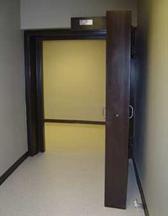
Heavy steel
door for a high energy radiation treatment room. |
Leaded windows were eventually replaced by CCTV cameras
when more powerful radiation treatment machines were utilized. The first
cameras generated black and white images, but when color cameras became more
compact, reliable and affordable, black and white cameras were phased
out.
As with many technologies, radiation treatment machines were
becoming more powerful. This necessitated the use of heavier lead lined or
steel doors. Doors became so heavy that radiation treatment machine operators
could no longer close the doors manually. This led to using hydraulic or
electric drive systems to operate the door.
Some cancer treatment facilities
went with a different approach. They felt that longer mazes were the solution,
thereby avoiding heavy doors, finger pinching and serious mechanical or
electrical failures.
The energy of the radiation treatment machines
increased even more and eventually exceeded the 10MV. For the first time
radiation treatment machines were producing both X-ray and neutron radiation.
Neutrons behaved completely different compared to an X-ray beam and resulted in
the use of massive doors for rooms with no or short mazes or a combination of
an X-ray and a Neutron door with complex interlock systems to prevent accidents
due to human error or safety equipment failure.
Again some cancer
organizations decided that complexity could be avoided by designing rooms with
a longer maze having neutron absorbent materials in its walls. The inherent
safety of a longer maze often allowed a light wooden door or a maze with no
door at all. The majority of cancer centres in Canada have doorless entry
systems for their radiation treatment rooms. This avoids the many safety and
maintenance concerns related to heavy doors.
The president of ISTAVA Inc has been involved for the last 15 years
in the design and installation of doorless entry systems in Canada. As an
active member of a provincial design team, he has advocated doorless and
treatment room universality.
The sophistication of the doorless
interlock system has grown from a simple relay circuit with warning lights and
a couple of sensors to a dual computer system with safety redundancies, self
diagnostic programs, LCD displays, interfaces to 3rd
party supplied devices and the ability to monitor adjacent
unshielded rooms. |
|
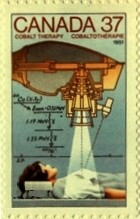
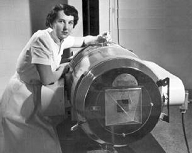
Canadian
postal stamp celebrating 50 years Cobalt treatments. |